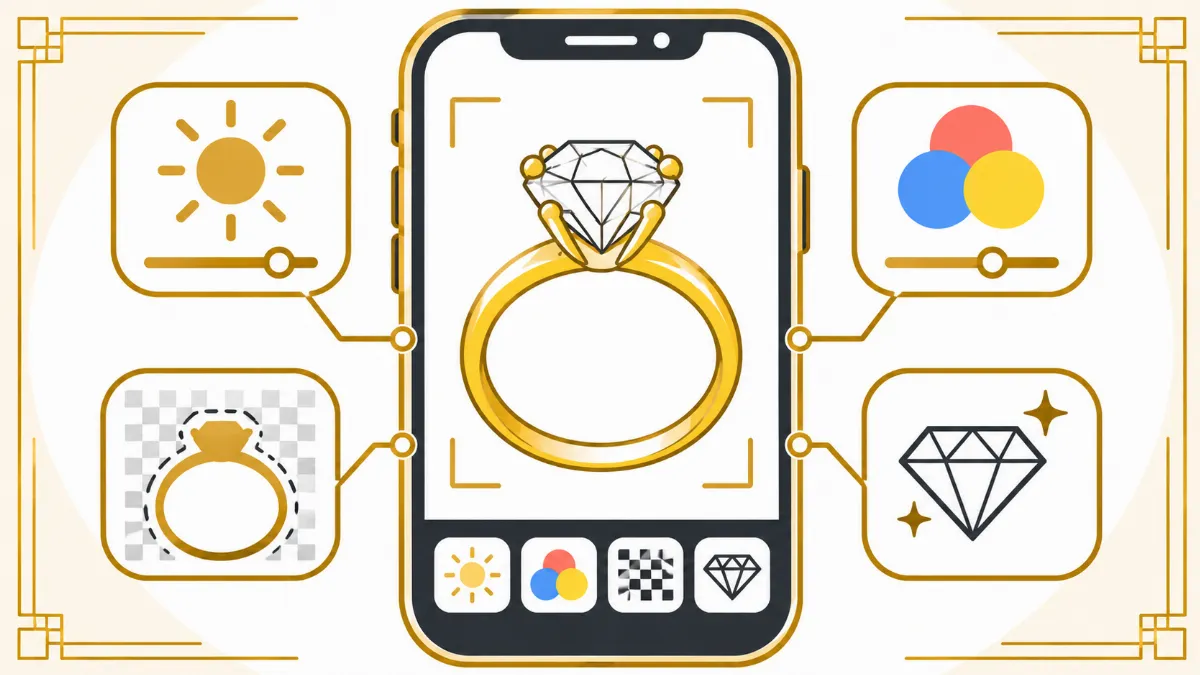
Jewelry photography is one of the most challenging types of product photography. Rings, necklaces, bracelets, and earrings contain small details that can be difficult to photograph accurately. Reflective metals, polished surfaces, and gemstones can create unwanted reflections, distracting shadows, and visible imperfections. Even professional photographers sometimes struggle to produce a finished image directly from the camera.
This is where jewelry photo retouching becomes useful.
Jewelry photo retouching is the process of carefully editing jewelry photographs to improve their appearance while keeping the original product design intact. It involves removing unwanted reflections, cleaning metal surfaces, correcting colors, sharpening details, and preparing images for websites, advertisements, and online marketplaces.
For jewelry businesses, product photographs are often the first thing customers see. Before reading the product description or checking the price, shoppers usually examine the image. They want to see the gemstone, metal finish, shape, and craftsmanship before deciding to purchase.
A photograph with distracting reflections or unclear details may make it difficult for customers to evaluate the product. On the other hand, a professionally edited jewelry image can help customers see the item more clearly.
In this article, we will explain what jewelry photo retouching is, how the process works, why jewelry businesses use it, and how professional editing can support online jewelry sales.
What Is Jewelry Photo Retouching?
Jewelry photo retouching is a specialized photo editing process that improves the visual quality of jewelry photographs without intentionally changing the product's actual design.
Unlike basic photo editing, jewelry retouching requires close attention to small details. A single ring may contain multiple reflective surfaces, gemstone facets, metal textures, prongs, engravings, and decorative elements.
Each component requires careful editing to maintain a natural appearance.
For example, a gold ring may have dark reflections caused by the photography equipment or surrounding environment. A jewelry retoucher can reduce these reflections while keeping the natural appearance of the gold.
Similarly, a diamond may appear slightly unclear because of lighting or camera limitations. Careful editing can improve the visibility of its existing facets without changing its actual shape or structure.
Jewelry photo retouching commonly includes:
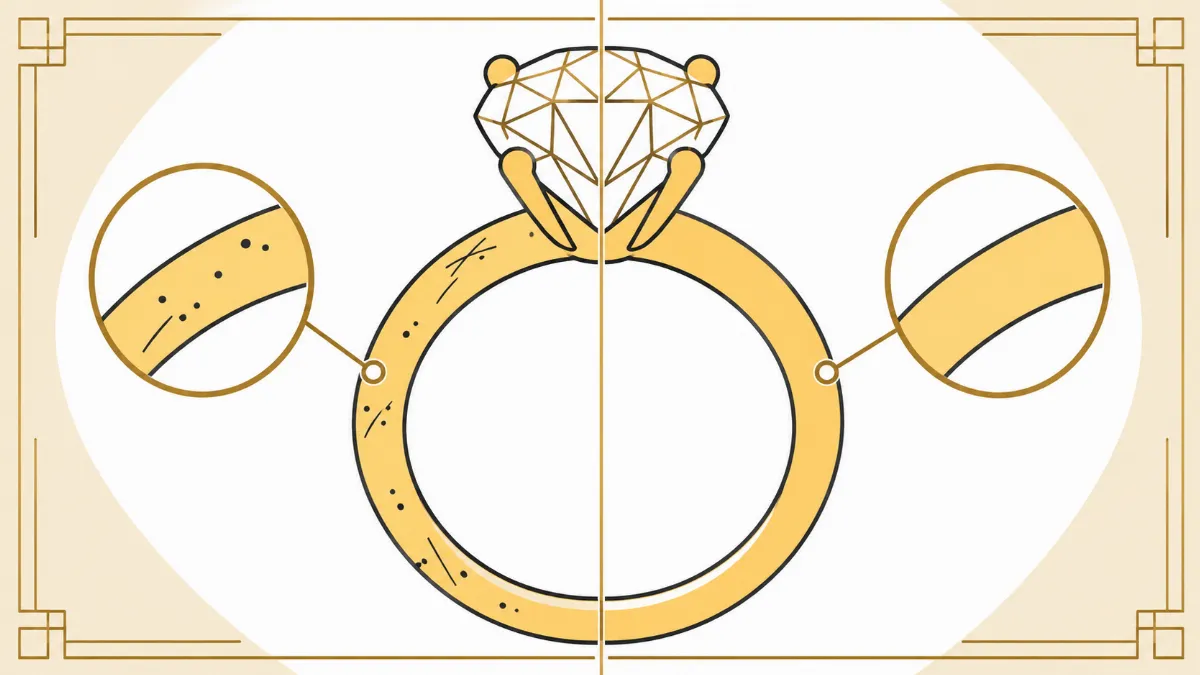
Removing unwanted dust, fingerprints, and surface marks.
Reducing distracting reflections on polished metals.
Correcting inaccurate gold, silver, and gemstone colors.
Improving the clarity of existing gemstone details.
Cleaning and correcting product backgrounds.
Adjusting brightness, contrast, and exposure.
Refining jewelry edges and removing background artifacts.
Preparing consistent images for online jewelry catalogs.
The purpose is not to make jewelry look like a different product. Instead, professional retouching helps present the jewelry accurately and attractively.
For jewelry brands, manufacturers, photographers, and online sellers, this process is an important part of preparing product images for commercial use.
Why Is Jewelry Photography Difficult?
Jewelry is challenging to photograph because of its materials, size, and reflective properties.
Unlike clothing, furniture, or ordinary household products, jewelry often contains several materials within a small area. A single engagement ring might include a polished gold band, a diamond centerpiece, multiple prongs, and smaller accent stones.
Each material reacts differently to light.
Reflective Metal Surfaces
Gold, silver, platinum, and other polished metals reflect their surroundings.
During photography, the jewelry may reflect the camera, studio equipment, lighting panels, or nearby objects. These reflections sometimes create dark patches or unusual shapes across the metal.
Some reflections are necessary because they help communicate the product's shape and polished finish. However, distracting reflections may need to be reduced during editing.
Small Gemstone Details
Diamonds and gemstones contain tiny facets that interact with light.
Depending on the lighting setup, some facets may appear darker or less defined than others. Certain areas may also look soft because the camera cannot keep every part of the jewelry in focus.
Professional retouching can improve the visibility of details already present in the photograph. However, severely blurred or missing information may require another photograph or focus stacking.
Dust and Fingerprints
Even carefully cleaned jewelry can contain small particles of dust, fingerprints, and polishing residue.
These marks may not be visible to the naked eye, but macro photography can make them noticeable.
Retouching removes distracting marks while maintaining the product's real texture and craftsmanship.
Lighting and Color Differences
Lighting can affect the appearance of gold, silver, and colored gemstones.
For example, yellow gold may appear too orange under warm lighting, while white gold may appear gray or slightly blue.
Color correction helps the photographed jewelry more closely match the actual product.
Why Do Jewelry Businesses Need Photo Retouching?
Jewelry businesses depend on product photographs to communicate the appearance, quality, and details of their merchandise.
Customers shopping online cannot physically inspect the jewelry. They rely on photographs to evaluate its shape, finish, gemstone arrangement, and overall appearance.
Professional jewelry photo editing can make this process easier.
1. Improve the Appearance of Jewelry Product Images
One of the main reasons businesses use jewelry photo retouching is to improve the appearance of their product photographs.
Unwanted reflections, fingerprints, dust, and distracting background elements can draw attention away from the jewelry itself.
Retouching removes these distractions so customers can focus on the product.
For example, a diamond engagement ring photographed against a white background may have several dark reflections along its metal band. Carefully reducing these reflections can produce a cleaner photograph without changing the ring's design.
The result is a more polished presentation suitable for jewelry websites, catalogs, and advertisements.
2. Help Customers Examine Product Details
Jewelry customers often want to inspect small details before making a purchase.
They may want to see the shape of a diamond, the arrangement of gemstones, the width of a ring band, or the design of a necklace clasp.
If these details appear unclear, customers may find it difficult to evaluate the product.
Professional jewelry retouching can improve local sharpness and contrast where the original photograph contains enough detail.
Clearer images help customers examine the jewelry and compare products more easily.
However, editing should never invent gemstone facets, alter engravings, or create details that do not exist in the original product.
3. Create Consistent Jewelry Product Listings
Consistency is important for online jewelry stores.
Imagine browsing a jewelry website where some product images have gray backgrounds, others have yellow backgrounds, and several contain different lighting conditions.
The inconsistent presentation may make the catalog look disorganized.
Professional retouching helps businesses establish a consistent visual style across their product collections.
This may include using similar background colors, product positioning, image dimensions, brightness levels, and shadow styles.
A consistent presentation makes it easier for customers to browse and compare jewelry products.
It also helps maintain a recognizable visual identity across the website.
4. Support Customer Confidence
Customers need reliable information when purchasing jewelry online.
Since they cannot physically examine the item, they depend on product descriptions, specifications, customer reviews, and photographs.
Clear product photographs can help customers evaluate the item before purchasing.
For example, a customer buying a gold necklace may want to inspect the chain design, clasp, pendant size, and metal finish.
Providing detailed, accurately edited images can help answer some of these questions.
However, jewelry retouching should remain realistic. Excessive editing that changes the appearance of the product may lead to incorrect expectations and customer dissatisfaction.
5. Prepare Images for Different Marketing Platforms
Jewelry businesses often use the same product photographs across several platforms.
These may include:
Online jewelry stores.
E-commerce marketplaces.
Social media advertisements.
Printed jewelry catalogs.
Promotional brochures.
Email marketing campaigns.
Digital product presentations.
Each platform may have different image requirements.
Professional jewelry photo editing can help prepare photographs with suitable backgrounds, dimensions, file formats, and resolutions.
For example, an online marketplace may require a clean product image against a white background, while a social media advertisement may use a lifestyle photograph.
Retouching allows businesses to prepare suitable versions while maintaining the appearance of the original jewelry.
What Does Professional Jewelry Photo Retouching Include?
Jewelry retouching involves several editing techniques. The exact process depends on the jewelry material, photography quality, and intended use.
Below are some of the most common services.
Background Removal and Replacement
Background removal separates the jewelry from its original surroundings.
This process is useful when the original background contains unwanted objects, uneven colors, or distracting elements.
The jewelry can then be placed against a clean white, transparent, or neutral-colored background.
For e-commerce businesses, background removal helps create consistent product listings.
However, the jewelry's original edges, fine chains, transparent gemstone areas, and natural shadows require careful attention.
Poor background removal may produce jagged edges, missing details, or unrealistic outlines.
Dust, Scratch, and Spot Removal
Macro jewelry photography can reveal small marks that are difficult to notice in person.
These may include fingerprints, dust particles, polishing residue, and temporary surface marks.
Retouchers use tools such as the Healing Brush, Clone Stamp, and carefully controlled masking techniques to remove unwanted marks.
The goal is to clean the photograph without removing permanent product characteristics.
Engravings, intentional textures, hallmark markings, and important design details should be preserved unless the client specifically requests an appropriate change.
Metal Reflection Retouching
Reflection control is one of the most detailed parts of jewelry photo editing.
Polished metal surfaces naturally reflect their surroundings, including lighting equipment and nearby objects.
Some reflections help define the jewelry's curves and metal finish. Others create distracting black patches or uneven tones.
A professional retoucher carefully reduces unwanted reflections while maintaining the metal's natural appearance.
Gold should still look like gold, silver should retain its characteristic finish, and platinum should not appear artificially painted.
Excessive reflection removal can make jewelry look flat and unrealistic.
Diamond and Gemstone Retouching
Diamonds, emeralds, rubies, sapphires, and other gemstones require careful editing.
Each gemstone has its own color, transparency, surface characteristics, and internal structure.
Professional gemstone retouching may involve adjusting local contrast, reducing distracting reflections, and improving the visibility of existing facets.
However, the gemstone's actual color, cut, shape, inclusions, and proportions should remain accurate.
For example, a diamond should not be edited to appear larger, clearer in grade, or structurally different from the real stone.
Accurate gemstone presentation is particularly important when customers are making purchasing decisions based on photographs.
Jewelry Color Correction
Color accuracy is especially important for jewelry photography.
Yellow gold, rose gold, white gold, silver, and platinum have different visual characteristics.
Lighting conditions and camera settings can sometimes produce inaccurate colors.
Color correction adjusts white balance, saturation, and tonal values to help the photograph match the actual jewelry.
For example, a rose gold ring should retain its characteristic pinkish warmth rather than appearing yellow or copper-orange.
For colored gemstones, the editing process should preserve the genuine stone color instead of exaggerating saturation.
Jewelry Image Sharpening
Jewelry photographs contain many small details, including prongs, gemstone edges, metal grooves, and chain links.
Sharpening can improve the visibility of these details when they are already present in the image.
Professional retouchers usually apply sharpening selectively rather than sharpening the entire photograph equally.
This helps prevent unwanted halos, excessive noise, and artificial-looking textures.
Sharpening is useful for improving slightly soft details, but it cannot reliably recover information that was never recorded by the camera.
For severely out-of-focus jewelry, reshooting or focus stacking may provide better results.
How Does the Jewelry Photo Retouching Process Work?
A professional jewelry photo editing workflow usually follows several stages.
Step 1: Review the Original Photograph
The retoucher examines the image to identify unwanted reflections, dust, inaccurate colors, soft areas, and background problems.
The jewelry design, gemstone arrangement, and important surface characteristics are also reviewed.
Step 2: Clean the Jewelry Surface
Temporary marks, fingerprints, dust, and distracting spots are carefully removed.
Natural metal texture and permanent product details are preserved.
Step 3: Correct Reflections and Colors
Unwanted reflections are reduced while maintaining realistic metal highlights.
White balance and color adjustments are applied when necessary to match the actual jewelry.
Step 4: Refine Gemstones and Details
The retoucher improves the visibility of existing gemstone facets, prongs, edges, and decorative elements.
Local adjustments are used to avoid excessive processing.
Step 5: Prepare the Background
The background is cleaned, corrected, or replaced according to the client's requirements.
Natural contact shadows may be retained or refined to prevent the jewelry from appearing disconnected from the surface.
Step 6: Perform Quality Control
The finished photograph is checked against the original image.
This stage helps identify accidental changes to gemstone counts, prong positions, engravings, colors, or product proportions.
Step 7: Export the Final Images
The completed photographs are exported according to the required file format, dimensions, color profile, and intended platform.
Common formats include JPEG, PNG, TIFF, and WebP.
Jewelry Photo Retouching vs. Basic Photo Editing
Although jewelry photo retouching and basic photo editing share some techniques, they differ in the amount of detail required.
Basic photo editing commonly involves adjusting exposure, contrast, color balance, cropping, and general sharpness.
Jewelry photo retouching goes further by working on individual product components.
For example, a basic photo editor may adjust the overall brightness of a ring photograph.
A jewelry retoucher may separately refine the metal band, gemstone facets, prongs, reflections, and background while preserving the jewelry's original structure.
This specialized approach requires patience, detailed masking, knowledge of reflective materials, and careful quality control.
The difference becomes more noticeable when editing complex jewelry with multiple gemstones or highly polished surfaces.
Can Jewelry Photo Retouching Help Increase Online Sales?
Professional jewelry photographs can support online sales by making product listings easier to evaluate.
When customers can clearly examine a jewelry item, they may feel more comfortable comparing it with other products.
Clean, consistent photographs also help create a professional shopping experience.
However, jewelry photo retouching does not automatically guarantee more sales.
Product pricing, descriptions, customer reviews, shipping policies, website usability, and brand reputation also influence purchasing decisions.
The value of retouching is that it improves the visual information available to shoppers.
For jewelry businesses that depend heavily on product photography, better image presentation may support engagement, customer confidence, and purchasing decisions.
Businesses can measure the results by comparing product page engagement, conversion rates, and customer feedback before and after updating their photographs.
Who Needs Professional Jewelry Photo Retouching?
Jewelry photo retouching is useful for businesses and professionals who regularly photograph jewelry products.
Online jewelry stores use retouching to prepare consistent product images for their websites and marketplaces.
Jewelry manufacturers use edited photographs to present collections, materials, and product variations to retailers.
Professional jewelry photographers may outsource detailed editing so they can spend more time photographing products and managing clients.
Luxury jewelry brands use carefully edited images for product catalogs, advertisements, and promotional materials.
Independent jewelry designers use retouching to present handmade rings, necklaces, bracelets, and earrings professionally.
Jewelry wholesalers may need large quantities of consistent product photographs for inventory listings and digital catalogs.
The editing requirements may differ depending on the business, but accurate product representation should always remain a priority.
How to Choose a Professional Jewelry Photo Retouching Service
Choosing a jewelry retouching provider requires more than comparing prices.
Jewelry editing involves small details that can be easily altered by inexperienced editors.
Before selecting a service, consider the following factors.
Review Previous Jewelry Editing Work
Ask to see before-and-after examples of jewelry photographs.
Pay attention to metal reflections, gemstone details, edges, background quality, and color accuracy.
The finished images should look natural rather than excessively smooth or artificial.
Check Their Experience With Different Jewelry Materials
Gold, silver, platinum, diamonds, and colored gemstones require different editing approaches.
A provider familiar with these materials is better positioned to maintain realistic colors and reflections.
Discuss Editing Instructions Clearly
Provide detailed instructions about what should be changed and what must remain untouched.
For example, you may request the removal of black reflections while preserving the original gold color, gemstone arrangement, and background.
Clear instructions help reduce unnecessary revisions.
Ask About Turnaround Time and Revisions
Jewelry businesses often work with product launches, seasonal collections, and advertising deadlines.
Ask the provider about delivery schedules, revision policies, and capacity for larger image batches.
Request a Sample Edit
A sample edit is a practical way to evaluate the provider's work.
Choose an image containing reflective metal, visible gemstones, and fine details.
Compare the result with the original photograph to determine if the editing meets your expectations.
Common Jewelry Photo Retouching Mistakes to Avoid
Poor jewelry retouching can create inaccurate or unrealistic product photographs.
One common mistake is removing too many reflections. Metal needs natural highlights and shadows to communicate its shape. Removing these entirely can make a ring look flat.
Another mistake is excessive sharpening. Strong sharpening can create halos around gemstone edges and make small details look artificial.
Incorrect color correction is also a problem. Yellow gold may become orange, silver may appear blue, and gemstones may look more saturated than they actually are.
Some editing processes accidentally alter gemstone counts, prong shapes, or decorative patterns. These changes are particularly problematic for commercial product images because they can misrepresent the item being sold.
Overly smooth metal surfaces can also remove natural polishing lines and textures.
The best jewelry retouching work improves presentation while preserving the details that make each product unique.
Is Professional Jewelry Photo Retouching Worth It?
For jewelry businesses that regularly publish product photographs, professional retouching can be a worthwhile investment.
It helps reduce distracting imperfections, maintain consistent product presentation, and prepare photographs for different marketing platforms.
Outsourcing retouching can also reduce the amount of editing work handled by photographers and internal marketing teams.
The actual value depends on image volume, editing complexity, service pricing, and business requirements.
For a small jewelry business, retouching a selected group of important product images may be a practical starting point.
For a larger jewelry retailer, establishing a consistent editing workflow can help manage hundreds or thousands of product photographs.
Regardless of business size, accurate product representation should remain the main objective.
Final Thoughts
Jewelry photo retouching plays an important role in preparing jewelry photographs for online stores, catalogs, and advertising campaigns.
From removing distracting reflections to correcting colors and refining gemstone details, professional retouching helps present jewelry clearly while maintaining its original design.
For jewelry businesses, quality product photographs make it easier for customers to examine materials, compare products, and make informed purchasing decisions.
However, successful jewelry retouching is not about making every surface perfectly smooth or every gemstone unrealistically brilliant. It is about balancing careful editing with accurate product representation.
If your jewelry photographs contain unwanted reflections, inconsistent backgrounds, unclear details, or inaccurate colors, professional jewelry photo retouching may help you prepare them for commercial use.
Looking for professional jewelry photo retouching services? Work with an experienced jewelry photo editing team that can clean product images, refine details, and maintain the natural appearance of your jewelry collection.